Konstantinos Parthenis: The Market for a Modern Greek Master
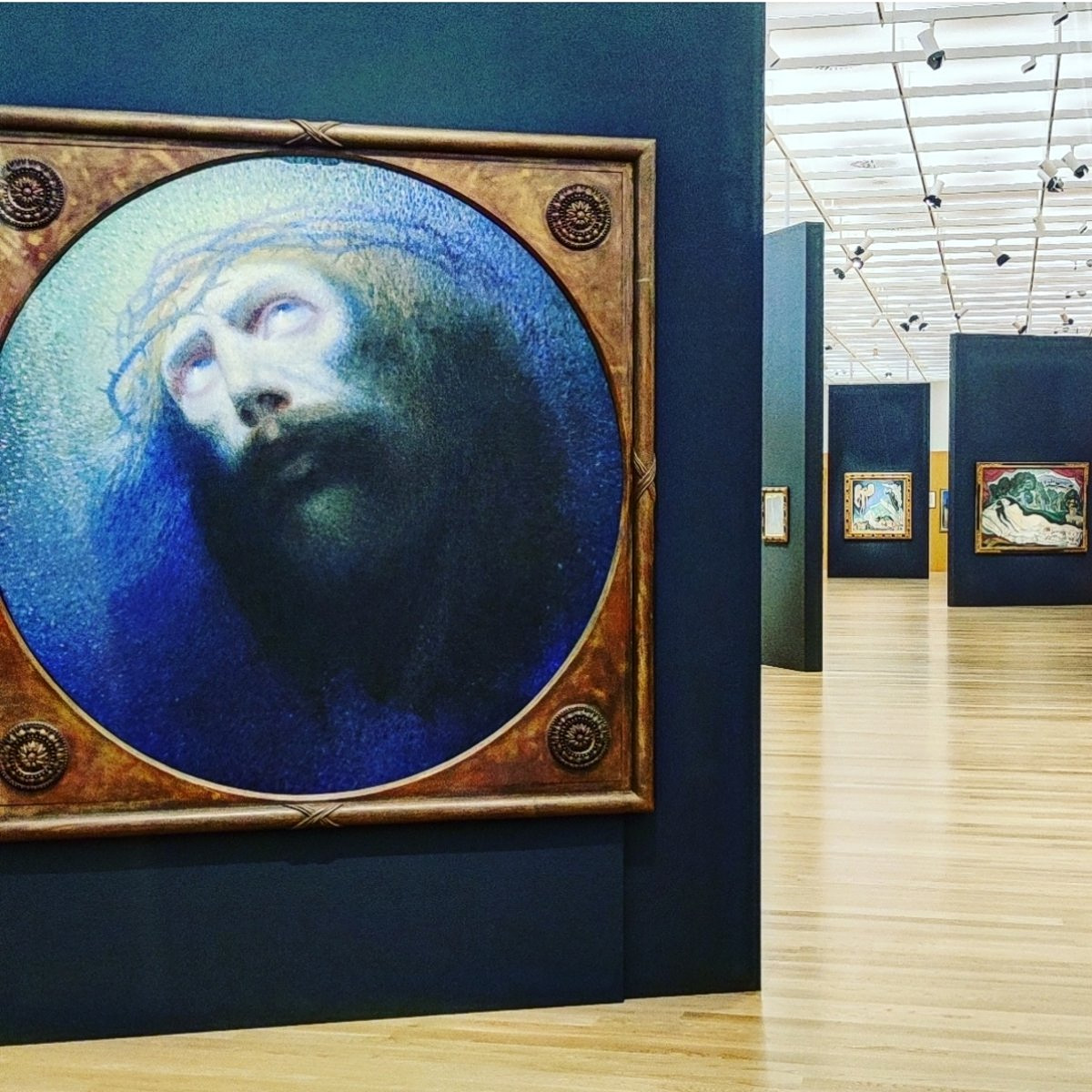
Konstantinos Parthenis stands as a foundational figure of Greek modernism, an artist who forged a unique path between European avant-garde movements and a deeply rooted Hellenic aesthetic. His cosmopolitan education in Alexandria, Vienna, and Paris allowed him to synthesize the spiritualism of Byzantine iconography with the formal innovations of Symbolism and Post-Impressionism. This critical legacy is now being mirrored by a powerful performance on the international art market. Recent decades have seen a dramatic rise in the value of his work, confirming his status beyond national borders. Landmark sales, such as the €644,313 achieved for 'The Apotheosis of Athanasios Diakos' in 2021, illustrate the sustained demand for the museum-quality works of a master whose vision remains both timeless and profoundly modern.
Few artists embody the transition of Greek art into modernity with the intellectual rigour and spiritual intensity of Konstantinos Parthenis. Born in cosmopolitan Alexandria in 1878, he was trained in Vienna at the height of the Secession, an experience that shaped his unique artistic path. While his contemporaries often chose between academic tradition and direct imports of French Impressionism, Parthenis forged a third way a highly personal synthesis of European Symbolism, Byzantine iconography, and an ethereal, idealised vision of the Greek landscape.
His early formation was crucial. Studying at the Academy of Fine Arts in Vienna from 1895 to 1903 placed him at the epicentre of Central Europe’s avant-garde. This, combined with a period in Paris absorbing the lessons of post-impressionism, allowed him to develop a distinctive vocabulary. Upon settling in Athens in 1917, he became a revolutionary figure, co-founding the pivotal 'Art Group' (Oμάδα «Τέχνη») to challenge the conservative establishment. His work eschewed pure representation in favour of a lyrical and almost metaphysical reality, defined by luminous, flattened planes of colour and elongated, graceful figures that seem to occupy a spiritual dimension.
Parthenis's influence was institutional as well as aesthetic. His appointment as a professor at the Athens School of Fine Arts in 1929 was a landmark event. Despite facing hostility from traditionalist colleagues, he mentored a new generation of Greek masters, including Yannis Tsarouchis and Nikos Engonopoulos. His home and studio, designed in collaboration with the great modernist architect Dimitris Pikionis at the foot of the Acropolis, became a legendary salon for Athens’s intellectual and artistic elite.
Despite international accolades, including a gold medal at the 1937 Paris International Exposition and an acquisition by the Italian state at the 1938 Venice Biennale, Parthenis’s later years were marked by a profound paradox. Disillusioned with institutional conservatism, he resigned his teaching post in 1947 and retreated into a self-imposed isolation that lasted until his death in 1967, living in relative poverty and seclusion.
This final-act silence stands in stark contrast to the resounding affirmation his work has received in the contemporary art market. The trajectory of his prices at auction reveals a steady and significant reappraisal, particularly over the last two decades. A watershed moment arrived in 2007, when his painting 'The Virgin and Child' achieved approximately £670,100 (€938,000 at the time) at auction, placing him firmly in the top echelon of modern Greek artists by value.
Demand for his major works has remained robust. In 2021, the monumental historical painting 'The Apotheosis of Athanasios Diakos' sold at Bonhams in Paris for €644,313, soaring past its €350,000–€550,000 estimate. The result confirmed the sustained international appetite for his premier works. More recently, in 2023, a work titled 'Pin' fetched €184,550 at the same auction house. Today, his large-scale oil paintings regularly command prices between €150,000 and upwards of €600,000.
The market for Parthenis is no longer a purely domestic affair. With major works now appearing regularly in sales in Paris and London, his legacy is being reassessed in a broader European context. This market ascendancy is not merely a reflection of a buoyant Greek art sector, but a definitive acknowledgement of his status as a singular and vital contributor to the complex narrative of 20th-century modernism.