Germaine Richier Retrospective Planned for Andros
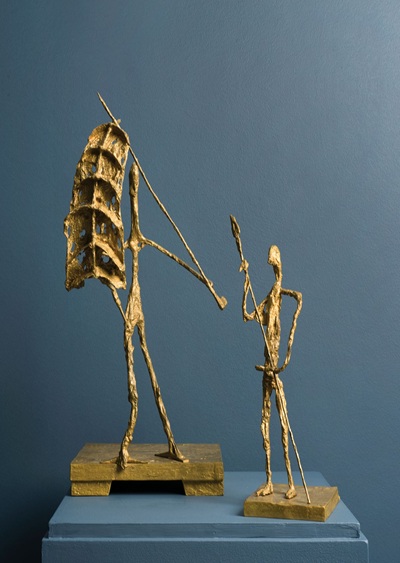
The Basil & Eliza Goulandris Foundation will present a major tribute to the sculptor Germaine Richier (1902-1959) at its Museum of Contemporary Art in Andros. Titled “Germaine Richier – Conversations,” the exhibition will run from 14 June to 27 September 2026, retracing the path of an artist whose work remained devoted to exploring living forms. A student of Antoine Bourdelle, Richier began in the academic tradition before developing a singular language of hybrid forms merging human, animal, and plant life. Her stature was confirmed with the Blumenthal Prize and her inclusion as the only female sculptor in MoMA’s 1955 exhibition, “The New Decade”.
The Basil & Eliza Goulandris Foundation will present a major tribute to Germaine Richier (1902-1959), one of European sculpture’s most significant figures, at its Museum of Contemporary Art in Andros. The exhibition, titled “Germaine Richier – Conversations,” is scheduled to run from 14 June to 27 September 2026. It will trace the complete artistic trajectory of a creator who, despite her premature death, left a remarkably coherent body of work dedicated to the exploration of living forms.
A student of Antoine Bourdelle, Richier began her career in the art of the bust, adhering to the rigours of academic tradition. Recognition arrived early, with the Blumenthal Prize at age 34. Her standing was solidified by her inclusion as the sole female sculptor in MoMA’s landmark 1955 exhibition, “The New Decade,” and by the major lifetime retrospective dedicated to her by the Musée National d’Art Moderne in Paris in 1956—an honour previously accorded only to Henri Matisse.
During the 1940s, Richier broke free from convention to develop a deeply personal sculptural language. Born and raised in Provence, she maintained a lifelong relationship with nature, animals, and insects. This affinity fuelled her imagination and is captured in her work, where the human element merges with the animal, plant, and mineral kingdoms to create hybrid, enigmatic figures.
The exhibition’s title, “Conversations,” refers to how the artist herself conceived of the relationship with her sculptures, which she called her children. The dialogue is twofold, encompassing both the creator’s exchange with her works and the invisible relationships the sculptures develop among themselves. These forms, often marked by cracks and signs of wear, express the paradoxes of the human condition. They embody fragility but also an indomitable inner strength, the instinct for survival, and a latent sense of hope.
The human figure remains the dominant subject throughout her career, evolving from classical busts to the abstracted silhouettes of the 1950s. Richier drew on the legacy of Rodin and Bourdelle, yet simultaneously shaped a radically new proposition that revitalised the art of sculpture, investigating the bond between humanity and nature while also borrowing from mythology and popular imagination.
The exhibition in Andros will also reference her studio, which the art critic Georges Limbour described as a “chaos of plaster and clay” and which served as the nucleus of her creativity. Her involvement with printmaking, an art she discovered in 1947 and integrated into her daily practice, will also be presented.
The exhibition is curated by Maria Koutsomalli-Moreau, Head of the B&E Goulandris Foundation Collection, and Laurence Durieu, a specialist in Richier’s work and the author of her biography. The survey will be accompanied by a comprehensive trilingual catalogue documenting this tribute to a unique voice in modern art.
Source: Days of Art in Greece