Venice's Hellenic Institute digitises five centuries of archives
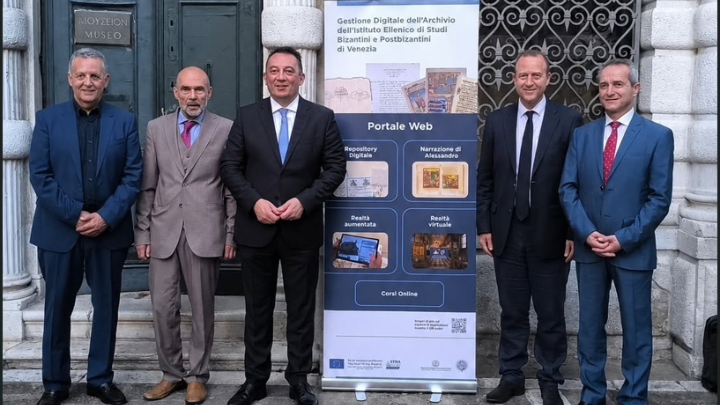
A cultural repository of immense value, charting five centuries of the Greek diaspora's history, is now accessible to a global audience. The project to digitise the Archive of the Hellenic Institute of Byzantine and Post-Byzantine Studies in Venice is complete, operating through the digital infrastructure of the Aristotle University of Thessaloniki. Through this platform, researchers and the public can explore a vast body of material illuminating the history of the Greek community from the 15th to the 20th century. The story of the Greek presence in Venice begins well before the community's official founding in 1498, with a wave of scholars and artists arriving after the fall of Constantinople in 1453.
An invaluable cultural repository, charting five centuries of the Greek diaspora's history, has been made accessible to a global audience. The project to digitise the Archive of the Hellenic Institute of Byzantine and Post-Byzantine Studies in Venice has recently been completed, now operating through the digital infrastructure of the Aristotle University of Thessaloniki. This new platform allows researchers, students, and the public to freely explore a vast body of material that illuminates the history of the Greek community from the 15th to the 20th century.
The history of the Greek presence in the Serenissima began long before the community's official establishment in 1498. Following the Fall of Constantinople in 1453, a significant wave of scholars, artists, and merchants sought refuge in Venice, bringing with them precious manuscripts and the intellectual heritage of Byzantium. The Greek community, the first to be formally organized 333 years before the founding of the modern Greek state, soon acquired its own church, San Giorgio dei Greci. Its construction was completed in 1577 under the supervision of architects such as Sante Lombardo and Zuanantonio Chiona, with the celebrated Andrea Palladio advising on the design of the women's gallery.
The Archive of the Greek Confraternity, and later of the Institute, covers the period from 1498 to 1954. It documents the life, activities, and evolution not only of the community in Venice but of the broader Hellenism under Venetian rule. After the Second World War, the movable and immovable property of the community was transferred to the Hellenic Institute of Byzantine and Post-Byzantine Studies, which stands today as its historical successor, preserving its memory and legacy.
The scale of the undertaking is impressive. A total of 140,000 documents, corresponding to approximately 1,000,000 high-resolution digital images, are now available. The collection includes 10,000 icons and ecclesiastical objects, 1,000 rare early printed books, and 47 precious Byzantine manuscripts. As the project coordinator, Professor Ch. Arabatzis of the Aristotle University of Thessaloniki, has emphasized, its educational value is immense. "Students no longer study copies or editions," he noted, "they essentially work with the primary sources themselves, in their physical form and chronological sequence."
Among the most significant documents made available is the celebrated "Alexander Romance" (Codex 5), a uniquely illustrated Byzantine manuscript from the 14th century. With 250 stunning miniatures decorated with gold leaf, the manuscript recounts the life and legends of Alexander the Great, who is depicted not merely as an ancient Macedonian king but as a Byzantine emperor and protector of Hellenism. The work, also accessible through an interactive application, is a renowned monument of world literature.
Equally compelling is the digitised collection of icons, which allows the viewer to trace the evolution of the Cretan School of painting from the 15th to the 17th century. Foremost among them are the works of Michael Damaskenos, the great Cretan painter who masterfully combined Byzantine tradition (maniera greca) with the innovations of the Italian Renaissance (maniera latina). Alongside his work are dozens of pieces by leading painters such as Georgios Klontzas, Emmanuel Lambardos, Theodoros Poulakis, and the brothers Emmanuel and Konstantinos Tzanes, as well as priceless icons brought from Constantinople by refugees, including Anna Palaiologina Notara.
The "Digital Management of the Venice Archive," as Professor Stratos Stylianidis, former Vice-Rector of the Aristotle University, remarked, is a project of "exceptional scientific and national importance." It represents not just a technological intervention but an "act of preserving collective memory and an investment in future research, education, and the dissemination of cultural heritage." Through this initiative, one of the most valuable archival collections of the Hellenic world is delivered to the public, while also connecting Greece with European programs like Europeana.
Source: Greek News Agenda — Arts