Nassos Daphnis and the Geometry of Greek Light
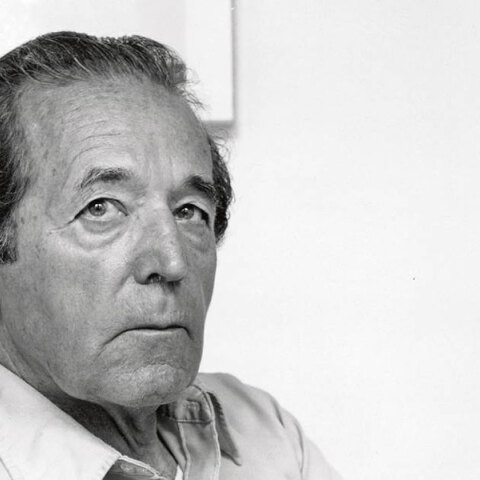
Among the significant figures of the Greek diaspora in post-war New York, Nassos Daphnis (1914–2010) holds a distinctive place. Born in Laconia, he emigrated to the US in 1930, becoming a pioneer of geometric abstraction while remaining largely unknown in his homeland for many years. A 1950 trip to Greece proved revelatory. As Daphnis later described, the intensity of the Hellenic light flattened forms and dissolved shadows, exposing their pure geometry. This experience prompted him to abandon his earlier figurative styles and devote himself entirely to abstraction.
Among the significant figures of the Greek diaspora who animated the post-war New York art scene, Nassos Daphnis (1914–2010) holds a distinctive place. Born in Krokees, Laconia, he emigrated to the United States in 1930 and established himself as a pioneer of geometric abstraction and public art. For many years, however, he remained a little-known figure in the country of his birth.
His artistic path, which included studies in New York, Paris, and Florence, was defined by a revelatory homecoming. During a trip to Greece in 1950, Daphnis experienced a fundamental shift in his perception of painting. As he later described, the intensity of the Hellenic light seemed to flatten everything, dissolving shadows and exposing the pure geometry of forms. This epiphany became the turning point that prompted him to abandon his earlier surrealist and symbolic language and devote himself entirely to abstraction.
Working within the hard-edge painting movement, Daphnis developed a recognisable personal idiom of strict geometric compositions, flat planes of colour, and sharp contrasts. His works, grounded in his own theory of primary colours, did not literally represent the Greek landscape but instead translated the experience of light into colour and structure. Greek mythology, a presence from his early career, was not abandoned but transformed. Pieces such as 'Ariadne's Golden Thread' (1988) and the 'Aegean' series do not narrate myths, but convert them into abstract, rhythmic compositions, showing how cultural memory can inform the most stringent geometry.
From the early 1960s, Daphnis’s interests expanded into the urban environment. As a founding member of the City Walls Inc. initiative, he was instrumental in the development of monumental mural art, altering the face of New York with iconic works such as his 1972 mural on the Times Square Arlen Building. The legacy of this practice is visible today in Athens, where a version of one of his early murals stands at the intersection of Kanari and Akadimias streets.
His international standing was solidified by his long association with the legendary Leo Castelli Gallery, where he exhibited alongside giants of the American avant-garde like Andy Warhol, Jasper Johns, and Robert Rauschenberg. A painter of innovative spirit, he began using a computer as a design tool as early as 1980. Today, his works reside in the collections of the world’s leading museums, including MoMA, the Metropolitan Museum of Art, and the Whitney Museum of American Art.
The core of Daphnis's contribution lies in this creative transformation: he proved that 'Greekness' is not exclusively a matter of iconography, but an essence that can be expressed as light, colour, and rhythm. His work, currently on view in exhibitions such as 'Abstract Constructions' at the Fondation CAB in France (until 31 October 2026), continues to affirm the power of an art that bridges ancestral memory with the universal language of the avant-garde.
Source: Athens Voice Εικαστικά