Germaine Richier: The French Sculptor Unveiled at the Goulandris Foundation Museum, Andros
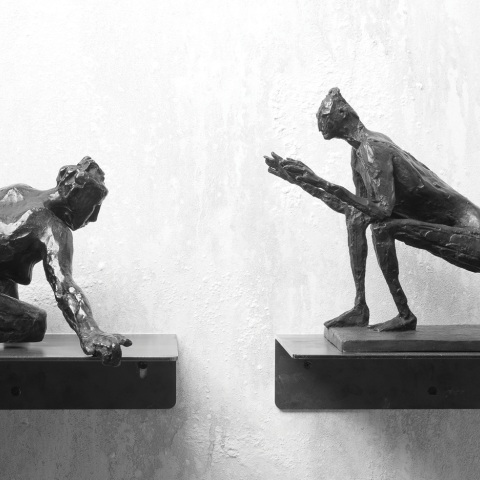
The Basil and Elise Goulandris Foundation Museum on Andros, renowned for its high-calibre exhibitions, is highlighting the significant, though partly overlooked, French sculptor Germaine Richier (1902-1959) this year. The exhibition, “Germaine Richier – Conversations,” curated by Maria Koutsomalli-Moreau and the artist’s niece, Laurence Durier, offers a deep dive into Richier's engagement with matter, nature, and the human condition. The Foundation’s long-standing appreciation for Richier is evidenced by four of her works in its permanent collection, testament to her early recognition by the founders. Richier, raised in Provence, infused her art with the spirit of the natural world, observing insects and wild flora. This led to a unique visual language where the human form undergoes constant transformation, resulting in hybrid figures like the “Mantis” and the “Bat,” blurring the lines between myth and reality.
The Basil and Elise Goulandris Foundation Museum on Andros, an institution renowned for its high-calibre exhibitions, is focusing this year on a significant yet partly overlooked figure of modern sculpture: the French artist Germaine Richier (1902-1959). Titled “Germaine Richier – Conversations,” the exhibition, curated by Maria Koutsomalli-Moreau and Laurence Durier, the artist’s niece, is not merely a presentation of works but a profound conceptual dive into the world of a creator who engaged in dialogue with matter, nature, and humanity itself. The Foundation’s connection with Richier is long-standing, with four of her works forming part of its permanent collection, attesting to the early recognition of her importance by the founders.
Richier, who grew up in Provence, imbued her art with the aura of southern French nature. Observing insects, birds, and wild vegetation from childhood, she developed a unique visual vocabulary where the human body undergoes constant metamorphoses. Her figures, such as the “Mantis,” the “Bat,” or the “Grasshopper,” are not simple representations but hybrid creatures teetering on the edge of myth and reality. She did not hesitate to incorporate pieces of nature—branches, tree trunks, stones—directly into her bronze sculptures, creating an indivisible whole where art mirrored life’s own processes.
Her relationship with her creations transcended mere technical execution. For Richier, sculptures possessed a soul. In her studio, she arranged them in pairs or groups, forging silent dialogues and invisible relationships between them, a practice replicated in the exhibition's layout. This quest for an inner truth led her to always work with live models, who endured exhaustive hours of posing. She was not interested in realistic depiction but in capturing the body's energy and essence at its mercy.
Her life and work were marked by the profound upheavals of the 20th century. During World War II, confined for six years in Switzerland, she created works depicting despair and collapse, exemplified by “The Walking Man” (1945), a tortured and physically eroded figure. Her return to Paris marked her most creative and recognised period, but also her most intense.
In 1950, a commission for a Crucifix for the Notre-Dame-de-Toute-Grâce church in Assy, a church decorated by Matisse, Braque, and Chagall, led to one of the greatest scandals in post-war art. The “Christ of Assy,” a bronze body that seemed to merge with a tree trunk, its form evoking a bat's skeleton, provoked outrage from conservative circles and was removed from the church. Intellectuals such as André Malraux defended her, but the sculpture was only reinstated in 1969, ten years after her premature death.
The exhibition on Andros, which follows the major retrospective at the Centre Pompidou in 2023, does not aim to chronologically exhaust Richier's oeuvre. Instead, it offers a rare opportunity for a meaningful “conversation” with her universe. The epilogue is a symbolic re-creation of her studio, a space filled with tools, natural materials, and miniature works, revealing her deep, almost poetic connection to the act of creation until her last breath.
Source: Athens Voice Εικαστικά